
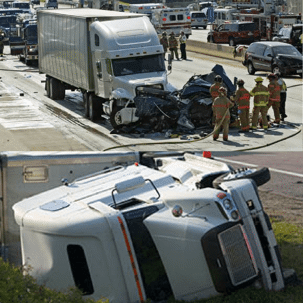
Seven hundred fifty-three people died on Mississippi roads in 2024.
Measured against how much we actually drive, that's the worst record in the country. The Insurance Institute for Highway Safety puts our rate at 1.81 deaths per 100 million miles traveled. The national figure is 1.19. Count it per resident instead and Mississippi still finishes last at 25.6 per 100,000, against 4.7 in Rhode Island at the other end.
You've heard some version of that before. It shows up in an editorial every couple of years, gets a round of headshaking, and then nothing much happens. What doesn't get repeated is the commercial truck piece of it. And that's where the state looks strange even by its own bad standards.
Trucks show up more often here
The federal government tracks what kinds of vehicles turn up in fatal crashes, state by state. In 2023, large trucks were 11 percent of the vehicles involved in fatal crashes in Mississippi. Nationally the figure was 9 percent.
Two points does not sound like much until you remember that it's two points on top of our State’s First Place in road deaths. Mississippi already leads the country in road deaths. Tractor-trailers are landing in that column more often here than they do in the nation at large.
The state's own numbers line up. Mississippi's Commercial Vehicle Safety Plan, put together with the Federal Motor Carrier Safety Administration, shows commercial vehicle crashes climbing from 1,430 in 2017 to 1,644 in 2021 — about 15 percent in five years. Commercial vehicle fatalities in that data hit 132 in 2021.
Who dies
This is the number that ought to change how people think about the trucks they pass every day, and almost nobody knows it. In 2024, 5,340 people were killed in crashes involving large trucks nationwide. Broken out the numbers look like this:
- 3,753 — 70 percent — were in other vehicles.
- 920 — 17 percent — were in the truck.
- 667 — 12 percent — were on foot, on a bicycle, or otherwise outside a vehicle.
Narrow it to the two-vehicle wrecks, one car and one tractor-trailer, and it gets starker still. IIHS found that in 2024, 96 percent of the vehicle occupants killed in those crashes were riding in the passenger vehicle.
That's not an argument about fault. A truck can be driven flawlessly and the car still loses. A loaded rig runs to 80,000 pounds on the interstate, and FMCSA describes large trucks as "often 20 to 30 times heavier than passenger vehicles." The mass settles the question before either driver has any say in it.
Where they happen
The Commercial Vehicle Safety Plan identifies the counties carrying the heaviest commercial vehicle crash load. Five counties took roughly a third of the state's total in 2021:
County | CMV crashes, 2021 |
Hinds | 139 |
Harrison | 109 |
DeSoto | 107 |
Rankin | 92 |
Jackson | 88 |
Together that's about 32 percent of the 1,644 statewide. The plan ties those concentrations to corridors anybody in this state can name — I-10 across Harrison and Jackson on the coast, I-20 through Hinds and Rankin, I-55 up through DeSoto.
When they happen, which is not when you'd think
Ask most people to picture a fatal truck wreck and they'll give you three in the morning on an empty highway, a driver who's been up too long, nobody around.
The data says otherwise, and it's not close. In 2024, 76 percent of fatal large-truck crashes happened on a weekday. Seventy percent of those weekday crashes happened in daylight. IIHS found 47 percent of large-truck crash deaths fell between 6 a.m. and 3 p.m., against 28 percent for crashes that didn't involve a truck. These are Tuesday morning wrecks. Ordinary traffic, ordinary light, roads people drive to work on.
The rural problem
Nationally, 56 percent of fatal crashes involving large trucks in 2024 happened on rural roads. Only a quarter happened on interstates. Mississippi is built almost perfectly wrong for that. The state's own safety planning documents count roughly 64,000 miles of rural roadway against about 10,000 urban miles. Call it 85 percent rural.
A two-lane highway has no median and often no shoulder worth the name. Traffic passes the other way at a few feet, closing at speeds that can top 120 miles an hour combined. And when something does happen out there, the ambulance has farther to come, which matters more than people realize in a crash where survival is a question of how fast you reach a trauma center.
The impact data reflects it. The most common configuration in two-vehicle fatal truck crashes is 30.7 percent front-to-front. Head-on. That's a two-lane road event, overwhelmingly.
Some context on exposure
Large trucks were about 10 percent of all vehicle miles traveled in the U.S. in 2024, and roughly 5 percent of registered vehicles. Against those denominators, 5,340 deaths a year is a lot of harm concentrated in a small slice of traffic. And it's been getting worse rather than better. Fatalities in large-truck crashes went from 4,095 in 2015 to 5,340 in 2024, up about 30 percent over the decade. IIHS, measuring from the 2009 low of 3,380, puts the increase at 58 percent.
What this doesn't tell you
Numbers describe patterns. They don't assign blame in any particular case, and nothing here is meant to.
Most truck drivers are careful people doing a hard job on somebody else's schedule. Most carriers would rather have their equipment right and their drivers rested than deal with what happens when they aren't.
But the consequences of a wreck land almost entirely on whoever's in the smaller vehicle, and that doesn't change based on who was careless. Ninety-six percent of the deaths in one of the two vehicles. That imbalance is the reason federal law puts a thick book of safety rules on motor carriers that applies to nobody else on the road — and it's why the question of whether those rules got followed matters as much as it does after a crash.
The rest of this series gets into what the rules require, where they tend to break down, and what you can do to keep from finding out firsthand.
Sources
- Insurance Institute for Highway Safety, Fatality Facts 2024: State by State — https://www.iihs.org/research-areas/fatality-statistics/detail/state-by-state
- Insurance Institute for Highway Safety, Fatality Facts 2024: Large Trucks — https://www.iihs.org/research-areas/fatality-statistics/detail/large-trucks
- National Highway Traffic Safety Administration, Traffic Safety Facts — Large Trucks: 2024 Data, DOT HS 813 816 — https://crashstats.nhtsa.dot.gov/Api/Public/ViewPublication/813816
- National Highway Traffic Safety Administration, Traffic Safety Facts — 2023 Data: State Traffic Data, DOT HS 813 743 — https://crashstats.nhtsa.dot.gov/Api/Public/ViewPublication/813743
- Federal Motor Carrier Safety Administration, Mississippi FY2025 Commercial Vehicle Safety Plan — https://www.fmcsa.dot.gov/sites/fmcsa.dot.gov/files/2026-03/FY%2025%20Mississippi%20CVSP%20-%20Final.pdf
- Federal Motor Carrier Safety Administration, Mississippi FY2024 Commercial Vehicle Safety Plan — https://www.fmcsa.dot.gov/sites/fmcsa.dot.gov/files/2024-11/Mississippi%20FY2024%20Final%20CVSP.pdf
- Federal Motor Carrier Safety Administration, Tips for Driving Safely Around Large Trucks or Buses — https://www.fmcsa.dot.gov/ourroads/tips-driving-safely-around-large-trucks-or-buses
- 23 C.F.R. § 658.17 (Interstate weight limits) — https://www.ecfr.gov/current/title-23/chapter-I/subchapter-G/part-658/section-658.17
This article is provided for general informational purposes only and does not constitute legal advice, nor does it create an attorney-client relationship. Every case turns on its own facts. Statistics cited are drawn from the public sources listed and reflect the data years indicated; figures are updated periodically by the issuing agencies. If you have questions about a specific situation, consult a licensed attorney. Coxwell & Associates, PLLC, 500 North State Street, Jackson, Mississippi 39201. Free background information available upon request.